Traditional Hiring Is Broken in 2026, Here's What's Replacing It
The old hiring process costs $15k per hire and fails 40% of the time. Learn why job posts and resumes don't work anymore—and what companies are doing instead in 2026.
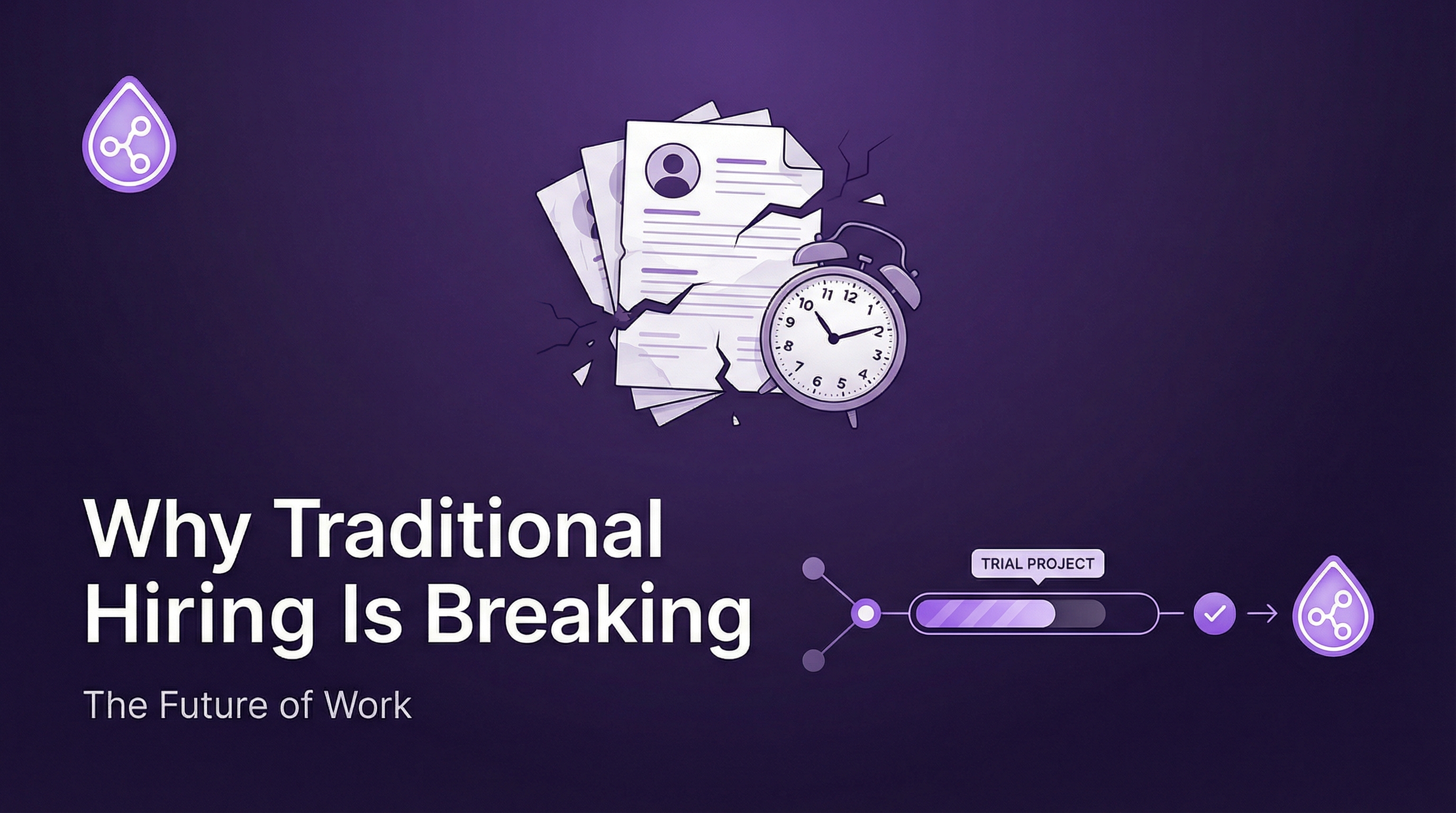

Companies are spending $15k per hire, waiting 3 months to fill roles, and still getting it wrong 40% of the time. The system is broken.
TL;DR
Traditional hiring (job posts, resumes, interviews) is slow, expensive, and inaccurate. New approaches like trial projects, async work samples, and AI-powered matching are replacing it.
For decades, hiring looked the same:
- Post a job description
- Wait for resumes
- Screen hundreds of applications
- Conduct 4-6 rounds of interviews
- Make an offer based mostly on gut feel
- Hope it works out
This process takes 2-4 months, costs $15k+ per hire, and results in bad matches 30-40% of the time.
In 2026, more companies are realizing: there has to be a better way.
Why It's Breaking Down
Resumes are theater: A resume tells you what someone wants you to think they can do. Not what they can actually do. Everyone says they're a "rockstar" with "excellent communication skills."
Interviews are performance art: The best interviewees are not always the best employees. Some people are great at talking about work. Others are great at doing work. These are different skills.
Job descriptions are wishlists: "5 years experience in a technology that's existed for 3 years." "Ninja rockstar unicorn." Job posts have become parodies of themselves.
The best candidates are not looking: Top talent is not scrolling job boards. They're busy doing great work. Traditional hiring only reaches people who are actively job searching.
Time-to-hire is killing companies: Waiting 3 months to fill a critical role means 3 months of lost productivity. In fast-moving markets, that's unacceptable.
Trial Projects
Instead of asking "can you do the work?" companies are saying "here's the work, show me."
- Paid trial projects (1-2 weeks)
- Async work samples
- Real problems, not whiteboard puzzles
Why it works: You see actual output. No guessing. No gut feel. Just results.
Example: A startup needs a designer. Instead of 5 rounds of interviews, they pay 3 candidates $2k each to design a feature. Best design wins the job. Everyone learns something. No wasted time.
AI-Powered Matching
AI is getting scary good at predicting job fit.
- Analyze actual work samples, not resumes
- Match communication styles
- Predict culture fit based on real data
- Surface non-obvious candidates
Why it works: AI can process way more signal than a human recruiter. It finds patterns humans miss.
Example: A company uses AI to analyze GitHub contributions, Stack Overflow answers, and blog posts. They find a senior engineer who never applied because they didn't see the job post. Direct outreach. Hired in 2 weeks.
Async-First Hiring
Remote work broke the "must be in office for interviews" model. Now hiring is going fully async.
- Record video answers instead of live interviews
- Async chat instead of phone screens
- Work samples instead of whiteboard problems
- Review on your schedule, not in real-time
Why it works: Respects everyone's time. No scheduling hell. Candidates show their best work, not their best improv.
Example: A remote company posts a project brief. Candidates submit solutions async. Top 3 get paid to build a more detailed version. Best one gets hired. Entire process happens without a single synchronous meeting.
Talent Networks
Why post jobs publicly when you can build a private talent network?
- Curated communities of pre-vetted talent
- Warm introductions instead of cold applies
- Continuous relationship building, not transactional hiring
Why it works: Trust and context. When someone you trust vouches for a candidate, the signal is 10x stronger than a resume.
Example: A founder spends 2 years building relationships with great engineers. When they need to hire, they reach out directly. No job post. No recruiter. Just "hey, want to work on this?" Hired in 1 week.
- Stop relying on resumes: They're the lowest-signal hiring tool. Use work samples, portfolios, and trial projects instead.
- Pay for trial work: If you want someone to prove they can do the job, pay them to do it. Spec work is disrespectful. Paid trials are investments.
- Build in public: The best way to attract talent is to show great work. Write about your challenges. Open source your tools. Be worth working with.
- Move fast: Top candidates get multiple offers. Speed wins. If your hiring process takes 3 months, you'll lose to the company that takes 2 weeks.
- Use AI for sourcing, not screening: AI is great at finding candidates. Terrible at rejecting them. Use it to surface hidden talent, not to auto-reject based on arbitrary criteria.
- Build in public: Your GitHub, blog, and side projects are your new resume. Show your work.
- Skip the applications: Direct outreach works better. Find companies doing interesting work and reach out directly.
- Offer trial projects: If a company won't pay for a trial, offer to do one anyway (if you can afford it). Proving your value beats talking about it.
- Focus on output, not credentials: Where you went to school matters less than what you've shipped. Show results.
- Build relationships before you need them: The best jobs come from your network, not job boards. Invest in relationships long before you're job searching.
In 5 years, traditional hiring will look as outdated as sending resumes by fax.
The future is:
- Work samples over resumes
- Trial projects over interviews
- AI-powered matching over keyword screening
- Async collaboration over office presence
- Relationship-building over transactional applying
Companies that adapt fast will win the talent war. Those that cling to the old model will struggle to hire.
The shift is already happening. The only question is how fast you'll adapt.
Ready to automate your workflow? Try Flowdrop and see how AI can amplify your productivity.
Related Resources
- The Death of the 40-Hour Work Week — How knowledge work is changing
- AI Agents Replacing Manual Workflows in 2026 — Automate repetitive work
- How to Automate Your Work Without Coding in 2025 — Practical automation for real people
Questions? Contact us or check out our documentation.
Frequently Asked Questions
About Flowdrop Team
We build AI workflow automation tools for non-coders. Our mission is to make automation accessible to everyone, so you can focus on work that actually matters.