Elon Musk Just Merged SpaceX and xAI Into a $1.25 Trillion Monster
SpaceX acquired xAI in the most ambitious vertical integration yet. The combined entity is heading for an IPO at $1.25T. Here's what actually happened and why it matters.

Elon Musk just did the thing everyone said he'd eventually do.
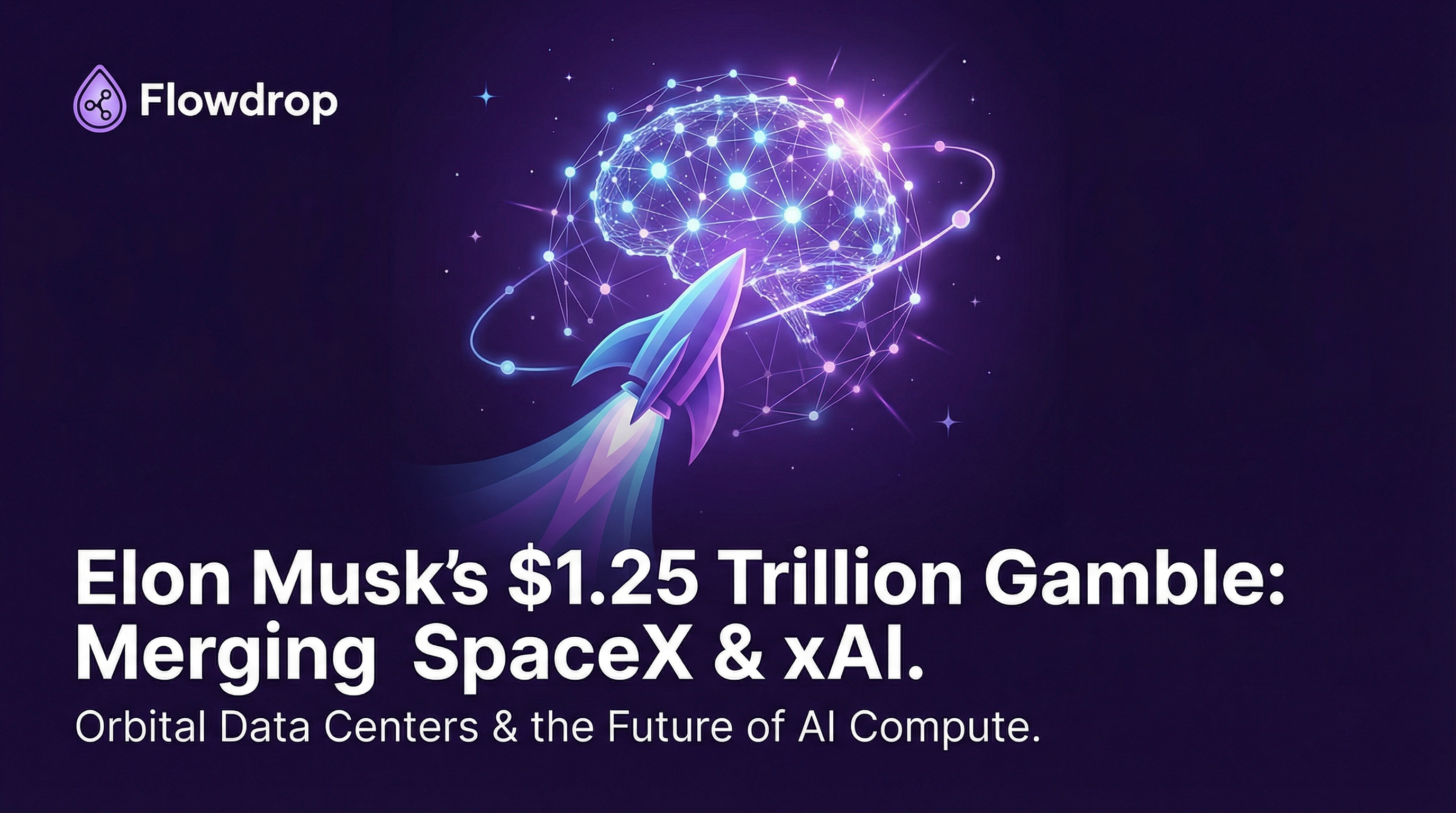
He merged SpaceX with xAI. The rocket company that dominates space launches is now officially tied to his AI startup. And the combined entity is heading for an IPO that could value it at $1.25 trillion.
Let that sink in. $1.25 trillion. That's bigger than most countries' entire economies.
On February 2nd, Musk announced that SpaceX acquired xAI in what he's calling "the most ambitious, vertically-integrated innovation engine on (and off) Earth." The deal brings together rockets, satellites, AI, and the X social platform under one roof.
Here's the structure: xAI becomes a wholly owned subsidiary of SpaceX. The combined company is gearing up for an IPO that Bloomberg says will price shares around $527 each, hitting that eye-watering $1.25 trillion valuation.
SpaceX was already worth $800 billion in its last private share sale. xAI closed a $20 billion funding round earlier this year at a $230 billion valuation. Add them together, sprinkle in some IPO hype, and you get... well, apparently $1.25 trillion.
The investors backing this thing read like a who's who of tech power players: Nvidia, Cisco, Fidelity, Qatar Investment Authority, Abu Dhabi's MGX, and Tesla just threw in $2 billion.
On the surface, combining rockets and AI sounds like Musk just playing SimCity with his companies. But there's a real strategic play here.
Musk's pitch is orbital data centers. He wants to put AI compute in space.
"My estimate is that within 2 to 3 years, the lowest cost way to generate AI compute will be in space," Musk wrote in his announcement. SpaceX recently asked the FCC for authorization to launch up to 1 million satellites as part of its "orbital data centers."
Think about what that means. AI training runs need massive amounts of power and cooling. Data centers on Earth are expensive, energy-intensive, and face regulatory headaches. Put them in space? You've got unlimited solar power, natural cooling in the vacuum of space, and way fewer NIMBY complaints.
Plus, SpaceX already has Starlink - 9,000 satellites in orbit serving 9 million customers. They know how to build, launch, and operate satellite networks at scale. Adding AI compute to that infrastructure is actually a logical extension.
This isn't Musk's first rodeo with merging his companies. Last year, he folded X (formerly Twitter) into xAI through a share swap. Back in 2016, he used Tesla stock to buy SolarCity.
What's emerging is what investors are calling the "Muskonomy" - a tightly integrated ecosystem where Tesla, SpaceX, xAI, Neuralink, and the Boring Company all feed into each other.
Tesla provides the cash flow and EV tech. SpaceX handles launches and satellite infrastructure. xAI develops the AI models. Neuralink works on brain-computer interfaces. X provides data and distribution. The Boring Company... well, they dig tunnels.
The synergies are real. xAI's Grok chatbot can use data from X. SpaceX can leverage AI for autonomous systems. Tesla benefits from AI development for self-driving. It's a flywheel that keeps accelerating.
But let's pump the brakes for a second. This deal isn't all moonshots and Mars colonies.
First, there's the regulatory nightmare. SpaceX holds billions in federal contracts with NASA, the Department of Defense, and intelligence agencies. Those agencies all have authority to review mergers for national security risks. Will they let a company that controls critical space infrastructure also control cutting-edge AI? That's an open question.
Second, xAI has serious baggage. The company faces regulatory probes internationally after its Grok AI tools enabled users to generate sexualized images of children and non-consensual intimate images of adults. That's not the kind of headline you want going into a $1.25 trillion IPO.
Third, there's community pushback. xAI's Colossus facility in Memphis has faced backlash over air pollution from gas-burning turbines. Residents in Mississippi are protesting noise levels from xAI equipment. Scaling this infrastructure globally won't be easy when local communities are already pushing back.
Fourth, the financials don't quite add up yet. SpaceX generated about $8 billion in profit on $15-16 billion in revenue last year, according to Reuters. That's solid. But xAI is still burning cash trying to catch up to OpenAI and Google in the AI race. The combined entity might be worth $1.25 trillion on paper, but the actual cash flows tell a different story.
The real story here is competition. Musk founded xAI in 2023 specifically to compete with OpenAI, the company he co-founded in 2015 but left in 2018. He's now in a heated legal battle with OpenAI and CEO Sam Altman.
By merging xAI with SpaceX, Musk is making a bet that vertical integration beats specialization. OpenAI is laser-focused on AI models. Google has search, cloud, and AI. Anthropic is building safer AI systems.
Musk's play is different: control the entire stack from rockets to satellites to AI models to social platforms. If he can pull off orbital data centers, he could have a structural cost advantage that nobody else can match.
But that's a big "if." OpenAI is prepping for its own IPO in Q4 2026 at an expected $500 billion valuation. Anthropic just became the preferred AI provider for several major banks. Google's AI division has more resources than anyone. The competition isn't sitting still.
Here's something most coverage is missing: SpaceX is already a massive defense contractor. Now it's merging with an AI company that the Pentagon just started using.
In January, the Department of Defense initiated use of Grok within the Pentagon. The DoD is letting military intelligence databases be analyzed using Grok, Google's Gemini, and other AI systems.
Connecting SpaceX's satellite infrastructure with xAI's models creates some interesting capabilities for defense applications. Real-time AI analysis of satellite imagery. Autonomous systems for space operations. Predictive models for threat assessment.
That's either really exciting or really concerning, depending on your view of privatized military-tech conglomerates.
The IPO is the immediate focus. If SpaceX-xAI can actually hit that $1.25 trillion valuation in the public markets, it would be one of the largest IPOs in history.
But the longer-term play is about fundamentally changing how we think about tech infrastructure. If Musk can prove that orbital data centers work at scale, it opens up entirely new possibilities for AI development, global internet access, and space-based services.
The skeptics will say it's too ambitious, too risky, too dependent on one person's vision. And they might be right.
But here's the thing about Musk: he's been counted out before. Electric cars wouldn't scale. Reusable rockets were impossible. Private space companies couldn't compete with governments. He proved the doubters wrong every time.
Maybe orbital data centers are next. Or maybe this is the merger that finally proves there are limits to what even Elon Musk can pull off.
Either way, we're about to find out. And it's going to be one hell of a show.
SpaceX acquiring xAI is the biggest tech merger we've seen in years. It creates a vertically-integrated giant that spans rockets, satellites, AI, and social platforms. The planned IPO could value it at $1.25 trillion.
The strategic logic is sound: use SpaceX's infrastructure to build orbital data centers that give xAI a cost advantage in the AI race. The execution risk is enormous: regulatory challenges, technical unknowns, and fierce competition from OpenAI, Google, and Anthropic.
For entrepreneurs, the lesson is clear: vertical integration can create defensible moats that pure-play competitors can't match. But it also requires massive capital, flawless execution, and a willingness to bet everything on a single vision.
Musk is making that bet. By the end of 2026, we'll know if it pays off.
Sources:
- CNBC: "Elon Musk's SpaceX acquiring AI startup xAI ahead of potential IPO"
- Bloomberg: SpaceX-xAI IPO valuation estimates
- Commercial Appeal: "SpaceX acquires xAI as Elon Musk looks to unify AI and space ambitions"
Want to see more stories about AI, automation, and the future of work? Try Flowdrop and see how AI can automate your workflows.
Related Resources
- AI Agents Replacing Manual Workflows in 2026 — How AI is changing work
- BizTrip AI Just Raised $1.5M to Fix Business Travel — Another big bet on AI
- Why Traditional Hiring Is Breaking — How work is changing in 2026
Questions? Contact us or check out our documentation.
Frequently Asked Questions
About Flowdrop Team
We build AI workflow automation tools for non-coders. Our mission is to make automation accessible to everyone, so you can focus on work that actually matters.